
FDM or SLA? How to choose for your part
Both are called “3D printing”, but they do not do the same job. The first question to ask is simple: will the part carry load, or will it be looked at?
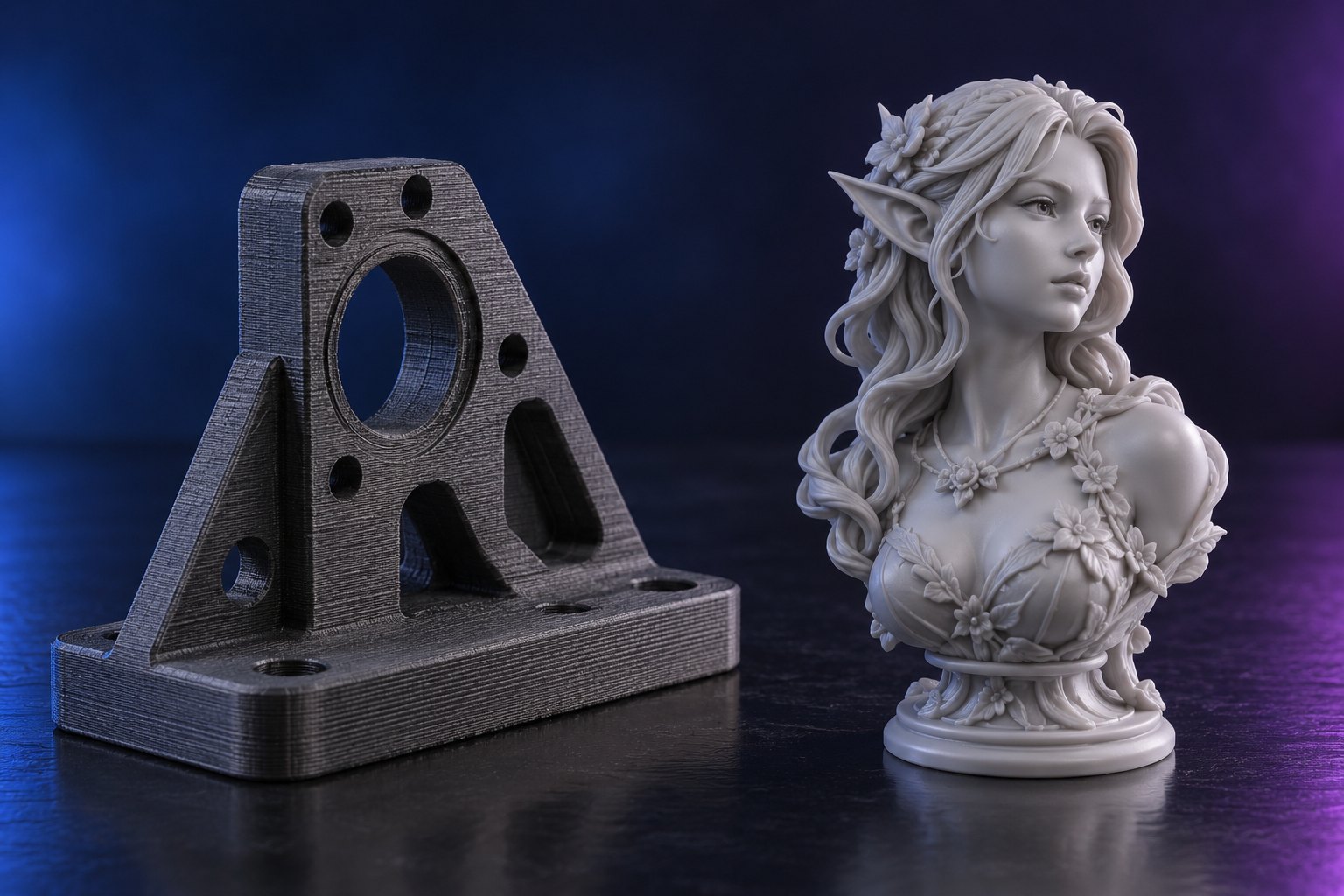
It is one of the first questions we get: “Should my part be FDM or SLA?” The answer almost always depends on what the part has to do. Below is how the two technologies compare, not in marketing language, but the way we see them at the bench.
Two methods, two different physics
FDM (Fused Deposition Modeling) pushes molten plastic filament through a fine nozzle and stacks it layer by layer. The part is made of the material itself: print in PLA and you hold PLA, print in ABS and you hold ABS. That means you can use the mechanical properties of engineering plastics directly.
SLA / resin printing cures liquid photopolymer point by point with UV light. Layer height drops to a tenth of FDM, so the surface comes out almost perfectly smooth. But what you hold is no longer a thermoplastic — it is a cured resin, and it behaves differently.
What is each good at?
Where FDM wins
- Load-bearing parts. Jigs, brackets, enclosures, fixtures, spare parts — anything that has to take impact or sustained load.
- Large volume. We print up to 800 × 800 × 1000 mm in one piece. SLA cannot reach those dimensions without splitting the part.
- Material range. PLA, PETG, ABS, PC, flexible TPU and carbon-filled PLA-CF, PA6-CF, PA12-CF, PPS-CF. You can choose by heat, chemical or impact resistance, or by flexibility.
- Cost. For the same volume, an FDM part is clearly cheaper; we can print it hollow and save material.
Where SLA wins
- Fine detail. 0.02–0.05 mm layers. Miniature facial features, thin connections, 0.3 mm protrusions all come out crisp.
- Surface finish. Layer lines are practically invisible; the part can be painted without sanding.
- Sharp edges and small lettering. Embossed logos, serial numbers, fine patterns.
- Casting and mould masters. Dimensional consistency is high for jewellery and investment casting work.
Side by side
| Criterion | FDM | SLA / resin |
|---|---|---|
| Layer height | 0.1 – 0.3 mm | 0.02 – 0.05 mm |
| Surface | Visible layer lines | Almost smooth |
| Mechanical strength | High, direction dependent | Medium, can be brittle |
| Heat resistance | 60–250 °C by material | Usually below 60 °C |
| Outdoor / UV | ABS, ASA, PC suitable | Yellows and embrittles over time |
| Maximum part | 800 × 800 × 1000 mm | Smaller build volume |
| Unit cost | Lower | Higher |
| Typical use | Functional parts, jigs, short runs | Figures, miniatures, presentation models, casting masters |
Five questions to decide
- Will the part carry load? If yes, FDM.
- Will it sit in sunlight or outdoors? If yes, FDM (ABS / ASA / PC).
- Will it see more than 60 °C? If yes, FDM with a suitable engineering plastic.
- Is the smallest feature under 1 mm? If yes, SLA.
- Will it be hand-painted or displayed? If yes, SLA.
If the answers conflict — say it has to be both strong and highly detailed — splitting the part and using both technologies is usually the cheapest route: body in FDM, detail piece in SLA.
Wrong choices we see often
A functional part ordered in SLA “because it is higher quality”. Resin looks better than FDM, but it can crack when screwed down or dropped. Unless it is a display piece, trading strength for surface finish is rarely worth it.
A miniature ordered in FDM to save money. You can print a 28 mm figure in FDM, but the facial features disappear, and the sanding and filling afterwards costs more than the price difference.
A PLA part that will live outdoors. PLA is cheap and easy to print, but it deforms within months in the sun. For outdoor use, PETG at minimum, preferably ASA or PC.
Not sure?
Tell us in one sentence what the part has to do and we will recommend the material and the technology. Quotes are free and we reply within an hour; if you have no file, a dimensioned sketch or a photo works too.