
Tool-free manufacturing: can 3D printing replace injection moulding?
Short answer: no, it does not replace it — but below a certain quantity it makes moulding pointless. Let us work out where that quantity sits.
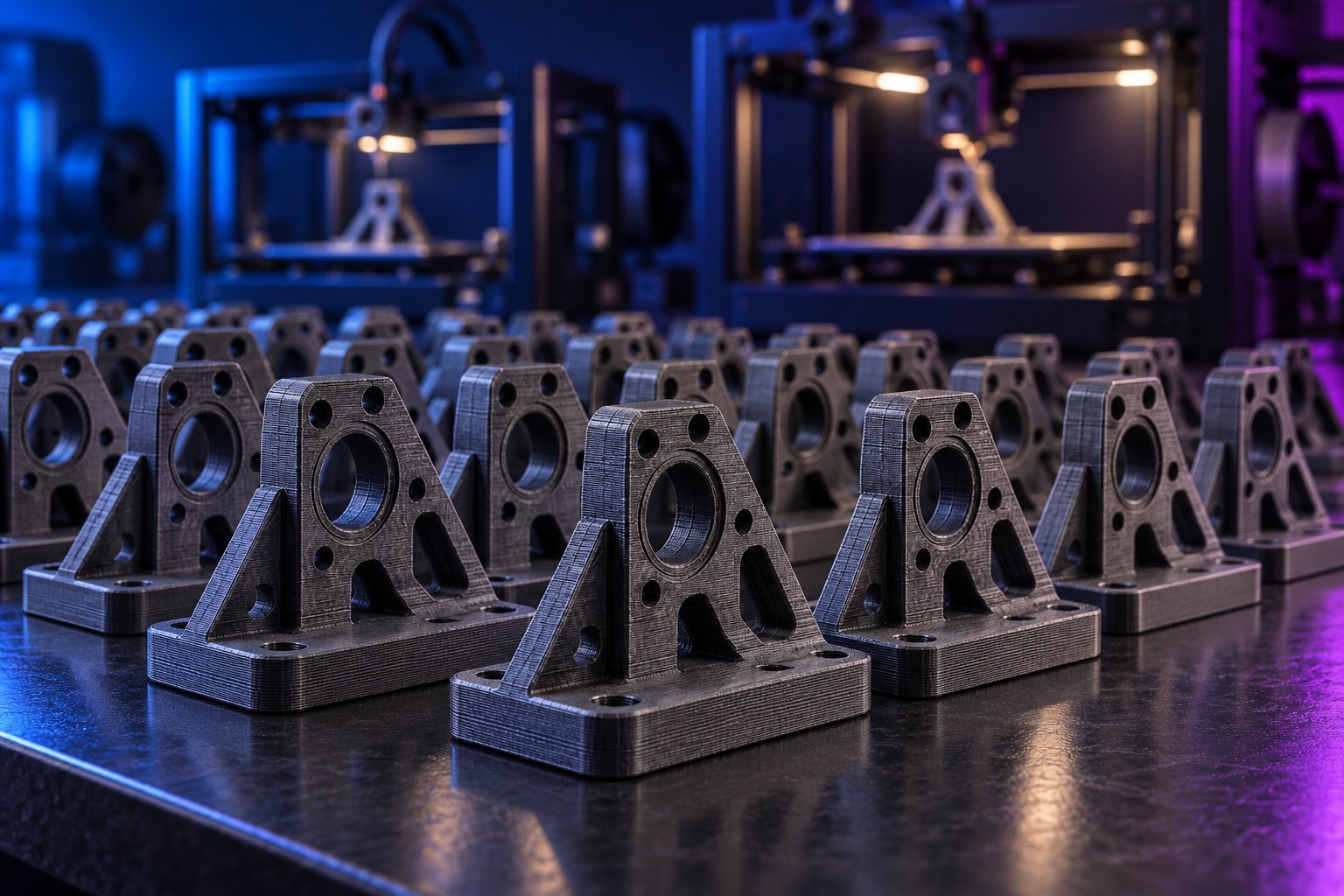
“Should we have this injection moulded or 3D printed?” largely comes down to one number: how many will you make? The two methods have completely different cost structures, so the winner changes as quantity grows.
Two different cost structures
With injection moulding, most of the cost lands at the very start: the tool. Tool design, steel machining, trial shots… That is a fixed cost, independent of how many parts you make. Once the tool exists, each part comes out very cheap — often just a few lira.
With 3D printing there is no tool. Setup cost is close to zero; the unit cost of the first part and the five-hundredth is almost the same. As quantity grows, only machine hours and material grow with it.
So one is “expensive first, then cheap”, the other is “cheap from the start, always the same”. The two curves cross somewhere.
Where is the break-even point?
Let us work an example. The figures are illustrative; they change considerably with the size, material and complexity of the part, but the logic holds.
- Tool cost: ₺60,000 (single cavity, moderately complex part)
- Injection unit cost: ₺12
- 3D printing unit cost: ₺95
The moulded unit cost falls as the tool cost is divided across the quantity: 60,000 ÷ qty + 12. 3D printing stays flat at ₺95. The two are equal at:
60,000 ÷ (95 − 12) ≈ 723 pieces
In this example 3D printing is cheaper up to roughly 700 pieces, and injection moulding takes over above that. If the tool is simpler and costs ₺25,000, the threshold drops to 300; if the part is larger and the printed unit cost is ₺200, the threshold drops to 320. There is no magic number — the sum is done per part.
But unit cost is not the whole story
Three items that never make it into the table often decide the question on their own:
1. Time
A tool takes weeks. With 3D printing, send the file in the evening and hold the part the next day. If an assembly line is down, the 700-piece calculation is irrelevant.
2. Cost of change
A tool is cut into steel; a 2 mm design change means a tool revision. With 3D printing a change is just an updated file and another print. Commissioning a tool while the design is still moving is the most expensive mistake there is.
3. Risk
If you commission a ₺60,000 tool and then sell 150 units, you are carrying over ₺400 of sunk cost per part. Going to market with printed parts first, seeing the demand, and only then moving to a tool is a far safer path.
Which job does each one win?
| Situation | Choice |
|---|---|
| Prototype, first sample | 3D printing |
| Runs up to a few hundred | 3D printing |
| Design still changing | 3D printing |
| Spare parts, discontinued products | 3D printing |
| Customised, one-off products | 3D printing |
| Production line jigs and fixtures | 3D printing |
| Thousands of units, frozen design | Injection moulding |
| Very thin walls, high surface finish required | Injection moulding |
Bridge production: using both
This is what works best in practice. You order the tool, and during the weeks before it arrives you fill the first orders with printed parts. Your launch is not delayed, and you get one last chance to revise the design with real feedback before the steel is cut.
In short
3D printing is not replacing injection moulding; it is filling the range where moulding is not economic. Up to a few hundred pieces, through every period when the design is moving, and for spare parts, tool-free manufacturing wins clearly. Once quantities reach the thousands and the design is frozen, a tool starts to make sense.
If you want to know which side your part falls on, send us the model and your target quantity and we will cost both scenarios.